
Publications 📄#
Welcome to my research publications! Here you’ll find my contributions to the field of computational mechanics, specifically focusing on phase-field methods for fracture and fatigue analysis. My work combines theoretical advances with practical software implementations, bridging the gap between cutting-edge research and real-world applications.
Publications#
A Correction Method for Crack Area Overestimation in Phase-Field Fracture
Authors: M. Castillón, J. Segurado, I. Romero, Year: 2026 Journal: Computational Mechanics DOI: 10.1007/s00466-026-02834-2
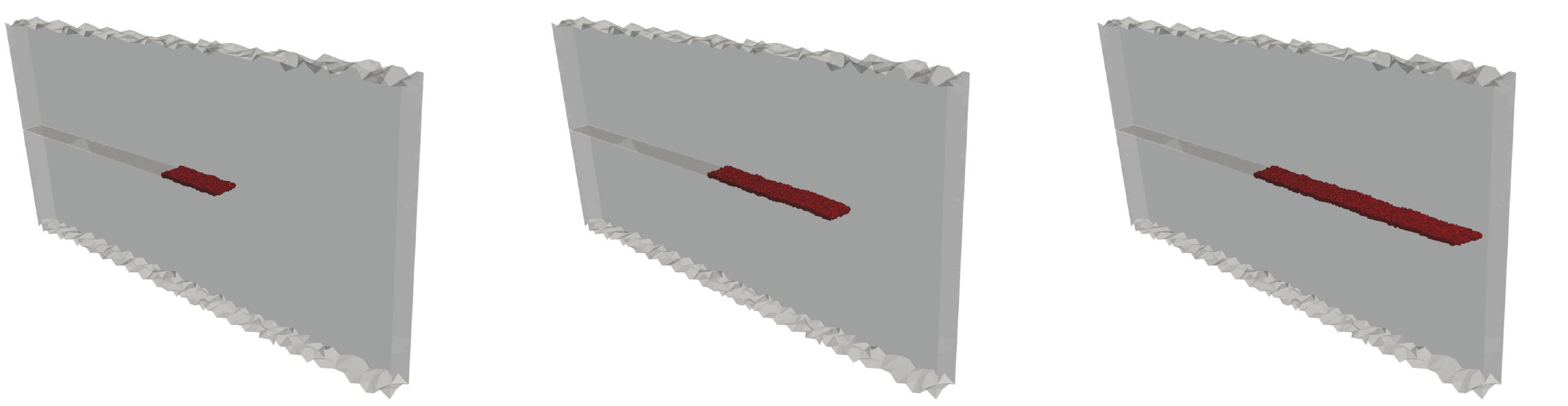
Phase-field fracture models are known to overestimate the crack area, a discrepancy that affects the accuracy of fracture predictions. This issue stems from the diffuse crack representation and numerical artifacts, such as strain localization, where the phase-field variable artificially saturates across finite elements. Existing correction strategies, including mesh-dependent factors and skeletonization algorithms, have limitations. Mesh-based corrections are often unreliable for unstructured meshes, while skeletonization can be complex and inaccurate for intricate crack topologies, especially in three dimensions. This paper introduces a correction framework to address this overestimation. Our approach is founded on the principle of energy equipartition, where the energy contributions from the phase-field and its gradient are equal as the length-scale parameter approaches zero. Since numerical artifacts primarily affect the phase-field term while leaving the gradient term largely unperturbed, we propose that the crack area can be approximated as twice the gradient-dependent energy. This method is inherently mesh-independent and readily applicable to the entire domain, including 3D simulations. The proposed methodology is validated against benchmarks with analytical solutions and compared with established methods like skeletonization to demonstrate its accuracy. It is then applied to complex geometries with curvilinear crack paths and evaluated in a three-dimensional simulation.
A Phase-Field Approach to Fracture and Fatigue Analysis: Bridging Theory and Simulation



Authors: M. Castillón, I. Romero, J. Segurado Year: 2025 Journal: International Journal of Fatigue DOI: 10.1016/j.ijfatigue.2025.109397
This article presents a novel, robust and efficient framework for fatigue crack-propagation that combines the principles of Linear Elastic Fracture Mechanics (LEFM) with phase-field fracture (PFF). Contrary to cycle-by-cycle PFF approaches, this work relies on a single simulation and uses standard crack propagation models such as Paris’ law for the material response, simplifying its parametrization. The core of the methodology is the numerical evaluation of the derivative of a specimen’s compliance with respect to the crack area. To retrieve this compliance the framework relies on a PFF-FEM simulation, controlled imposing a monotonic crack growth. This control of the loading process is done by a new crack-control scheme which allows to robustly trace the complete equilibrium path of a crack, capturing complex instabilities. The specimen’s compliance obtained from the PFF simulation enables the integration of Paris’ law to predict fatigue life. The proposed methodology is first validated through a series of benchmarks with analytical solutions to demonstrate its accuracy. The framework is then applied to more complex geometries where the crack path is unknown, showing a very good agreement with experimental results of both crack paths and fatigue life.
PhaseFieldX: An Open-Source Framework for Advanced Phase-Field Simulations

Authors: M. Castillón Year: 2025 Journal: Journal of Open Source Software Volume: 10(108) Pages: 7307 DOI: 10.21105/joss.07307
This publication introduces PhaseFieldX, an open-source framework for advanced phase-field simulations. The project includes comprehensive documentation and is actively maintained on GitHub.
Proximal Galerkin for Phase Field Fracture
Authors: M. Castillón, B. Khara, J. S. Dokken, T. M. Surowiec, B. Keith, Y. Bazilevs Year: 2026 Type: arXiv preprint arXiv: arXiv:2604.26210
This work introduces the proximal Galerkin (PG) framework for phase-field fracture problems. The method reformulates inequality-constrained optimization into a sequence of saddle-point problems with latent variables, enabling rigorous enforcement of irreversibility and boundedness constraints on the phase-field variable. The approach is applicable to both static and dynamic fracture simulations and demonstrates strong agreement with theoretical and experimental results while providing a unified variational framework for constrained phase-field modeling.
Doctoral Thesis#
Numerical Methods and Algorithms for Phase-Field Fracture Modeling
Author: M. Castillón Year: 2026 Institution: Universidad Politécnica de Madrid (UPM), Madrid, Spain Degree: PhD Thesis DOI: 10.20868/UPM.thesis.96840
This doctoral thesis presents novel numerical methods and algorithms for phase-field fracture modeling, with particular emphasis on fatigue crack propagation, crack area measurement, and robust constrained optimization techniques.
The computational challenge of fatigue—where conventional phase-field approaches often require cycle-by-cycle simulations over thousands of loading cycles—is addressed through a framework that enables fatigue analysis using only monotonic loading. A specialized energy-controlled solver robustly traces the complete crack equilibrium path, including snap-back instabilities, allowing the numerical extraction of the compliance rate with respect to crack area. By combining these results with Linear Elastic Fracture Mechanics (LEFM) and Paris’ law, fatigue life can be predicted with dramatically reduced computational cost.
To improve the accuracy of geometric quantities obtained from phase-field simulations, the thesis introduces the Double Gradient Correction Method (DGCM). Based on the principle of energy equipartition, DGCM provides a mesh-independent estimate of crack area by exploiting the gradient contribution of the phase-field energy, remaining applicable to complex crack topologies and three-dimensional problems.
The thesis also presents the Latent Variable Proximal Point (LVPP) algorithm, a robust framework for solving constrained phase-field problems. By reformulating inequality-constrained models through an auxiliary latent variable, LVPP transforms the original problem into a sequence of unconstrained saddle-point systems suitable for efficient Proximal Galerkin discretizations. The approach avoids the parameter sensitivity and convergence difficulties commonly associated with penalty-based methods.
All methodologies developed in this thesis are implemented in PhaseFieldX, ensuring reproducibility and providing an open-source platform for future developments in computational fracture mechanics.